Dr. Joy Wins UNC Charlotte 2026 Best Invention of the Year for a Wire That Works Even When Broken

Break a wire, and the signal stops. That has been true since the first telegraph line was strung in the 1830s. Dr. Soumitra R. Joy, Assistant Professor in UNC Charlotte’s Department of Electrical and Computer Engineering, has invented a wire for which it is not.
Dr. Joy has been awarded the UNC Charlotte 2026 Best Invention of the Year, selected by a panel of industry CEOs, Army representatives, and patent attorneys, for his patent on Signal Transmission by Engineered Wire Composed of Isolated Metallic Islands.
What It Is:
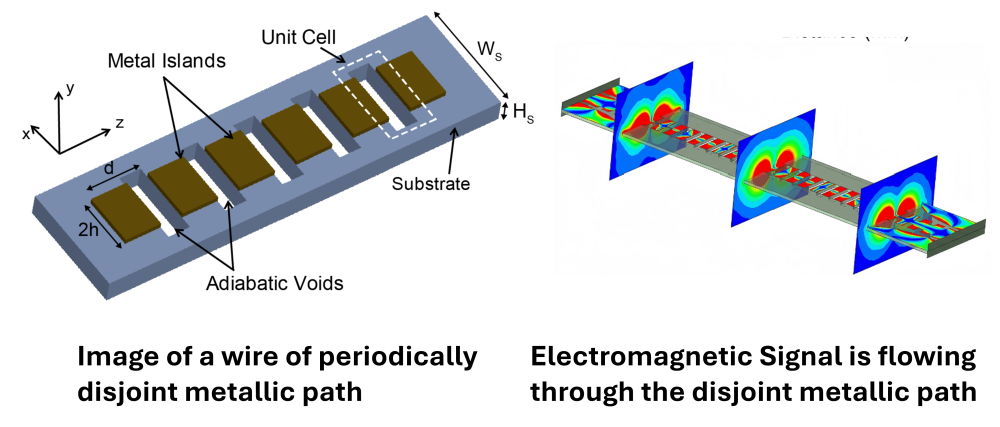
Instead of a continuous metal strip, Dr. Joy’s wire is a sequence of small metallic islands with deliberate gaps between them. No metal bridges connect adjacent islands. No ground plane runs beneath them. And yet, microwave and radio frequency signals travel through the structure as if the gaps were not there.
The mechanism is near-field electromagnetic coupling. Each island resonates at the signal
frequency and excites the next island across the gap, no physical contact required. The result is a guided-wave structure that transmits high-power RF signals while remaining electrically open from DC through low frequency. From an electromagnetic standpoint it is a wire. Structurally it is anything but.
Why It Matters
Standard wires do three things simultaneously: carry signals, conduct heat, and fail when the connecting metal breaks. Dr. Joy’s structure separates all three. The gaps block heat flow along the wire, giving it thermal resistance forty times higher than a copper microstrip of the same size. And because there are no metallic bridges to break in the first place, the structure is inherently tolerant of the very failure mode that ends the life of conventional wiring. Fatigue cracking, thermal cycling, and mechanical stress that would sever a standard conductor leave this wire unaffected. No existing technology achieves all of this together.
The Applications
In quantum computing, thousands of cables connecting room-temperature electronics to near-absolute-zero quantum processors create an unmanageable heat load as systems scale. Dr. Joy’s wire carries the signal while blocking the heat. These kinds of wire may also find interesting application in robotics and deployable systems, in automotive and military sensing, etc where chip dysfunctionality due to wire failure is a common incidence.
About Dr. Joy
Dr. Joy joined UNC Charlotte in 2024 as a tenure-track Assistant Professor after several years at Intel Corporation, where he developed modeling techniques for GaN transistor reliability. At UNC Charlotte he leads the High Frequency Device Laboratory, focused on novel electromagnetic devices for energy-efficient data communications.
“A signal path that carries no heat. A wire that works when the connecting metal is gone” Dr. Joy says. “Those are not incremental improvements. They are different ways of thinking about what a wire can be.”