Dr. Minhaj Alam Receives Highly Competitive $2.03 Million NIH R01 Award from the National Eye Institute
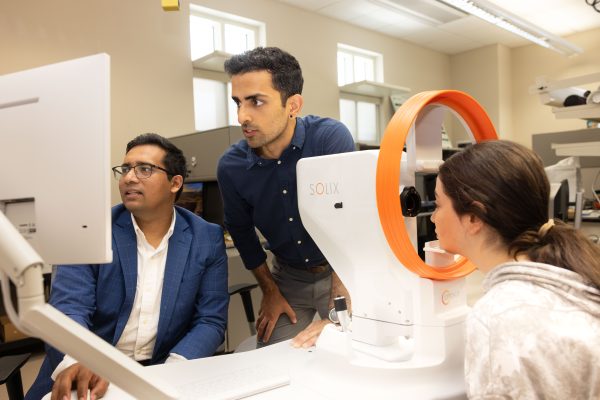
Dr. Minhaj Nur Alam, Assistant Professor in the Department of ECE at UNC Charlotte, has been awarded a $2.03 million National Institutes of Health (NIH) R01 grant from the National Eye Institute (NEI) to develop next-generation artificial intelligence (AI) technologies for ophthalmic imaging and vision care.
The award is the first ever NIH R01 research grant received by a faculty in UNC Charlotte’s College of Engineering and marks a significant milestone for the college’s growing biomedical research enterprise.
The four-year project, titled “Distributed Foundation Models for Multi-Task Learning in Diabetic Retinopathy,” will develop advanced AI systems capable of learning from retinal imaging, text, and clinical data collected across multiple healthcare institutions without requiring patient data to be centralized. The research combines expertise in federated learning, multimodal foundation models, and biomedical imaging to create more accurate, robust, and equitable AI tools for detection, prognosis, and treatment planning of diabetic retinopathy.
Diabetic retinopathy remains one of the leading causes of vision loss worldwide, affecting millions of patients. By enabling AI models to learn from diverse patient populations and imaging devices while preserving privacy, the project seeks to overcome major barriers that currently limit the clinical adoption of medical AI.
“This award enables us to develop a new generation of collaborative AI systems that can leverage data from multiple institutions while maintaining patient privacy,” said Alam. “Our goal is to create foundation models that improve disease prediction, treatment planning, and ultimately patient outcomes in ophthalmology.”
The project includes collaborations with leading academic medical centers and researchers across the United States and internationally, providing access to diverse retinal imaging datasets and clinical expertise.
Beyond ophthalmology, the technologies developed through this project have the potential to influence a broad range of biomedical and engineering applications involving distributed data, privacy-preserving machine learning, and foundation models. The work further strengthens UNC Charlotte’s leadership in artificial intelligence, biomedical engineering, and interdisciplinary health research.
For more information, please visit Dr. Alam’s research lab website.